A small electrical contractor in the Inland Empire can stay busy for the next two years and never touch an office tower. School districts are modernizing with fresh state bond money. Water agencies are spending climate dollars. Los Angeles County is rebuilding thousands of homes lost to fire. The same contractor can still lose money if a steel price jump lands between bid day and delivery, or if a compliance gap knocks the firm out of a job it should have won.
That is the California market heading into 2026. Public and rebuild work look strong, private commercial work is uneven, and costs remain hard to predict. The figures below come from public sources available in late 2025. Federal funding and tariff policy have changed often this year, so confirm details with the awarding agency before you price a job.
Where the 2024 bond money is going and who will award it
Voters approved three large bonds in 2024. That money is now moving out of planning and into design and construction, and it will produce bid opportunities through 2026 and beyond.
The largest for most readers is Proposition 2, the $10 billion school facilities bond passed in November 2024. About $8.5 billion goes to K-12 schools and $1.5 billion to community colleges. It pays for modernization, new construction, career technical education facilities, and health and safety upgrades. The K-12 share flows through the Office of Public School Construction and the State Allocation Board, so individual school districts will be the ones putting projects out to bid.
Proposition 4, the $10 billion climate bond approved the same month, covers water infrastructure, wildfire prevention, flood protection and parks. Its money moves through several state agencies, including the Department of Water Resources and CAL FIRE, and then out to local water districts, counties and other grantees. Proposition 1, the $6.38 billion behavioral health bond approved in March 2024, funds treatment facilities and housing for veterans and people experiencing homelessness. It is administered largely through the Department of Health Care Services and the Department of Housing and Community Development.
Much of this work comes in packages that small and mid-size firms can handle. Specialty trades such as HVAC, roofing, electrical and paving are especially well placed. The buyers are local, which means relationships with district facilities staff and county public works departments matter as much as low numbers.
Getting registered and on the lists before bond jobs hit the street
Paperwork knocks more qualified firms out of public work than price does. Get these steps done before the bid you want shows up:
- Register with the Department of Industrial Relations as a public works contractor. The annual fee is currently $400. Without it you cannot bid on most public works, so check DIR for the current fee and any small-project exemptions.
- Apply for Small Business or Disabled Veteran Business Enterprise certification through the Department of General Services on the Cal eProcure portal. Certification is free.
- Get on the bidders' lists for the school districts in your area. Districts building with state bond funds commonly require prequalification on larger projects, often those of $1 million or more, and that can extend to mechanical, electrical and plumbing subcontractors. Each district's bid documents spell out its rules.
- Watch State Allocation Board meetings and local school board agendas. Funding approvals and board actions are early signals of which projects are coming and roughly when.
- Set up certified payroll before you win a job. Prevailing wage applies to public works over $1,000, and certified payroll records go to DIR through its electronic certified payroll reporting system.
Timing matters with school work. Districts often want construction done during summer break, so many bond-funded jobs go out to bid in late winter and spring. If schools are a target, keep estimating capacity open from January through April.
Highway, transit and rail work: steady money with a few soft spots
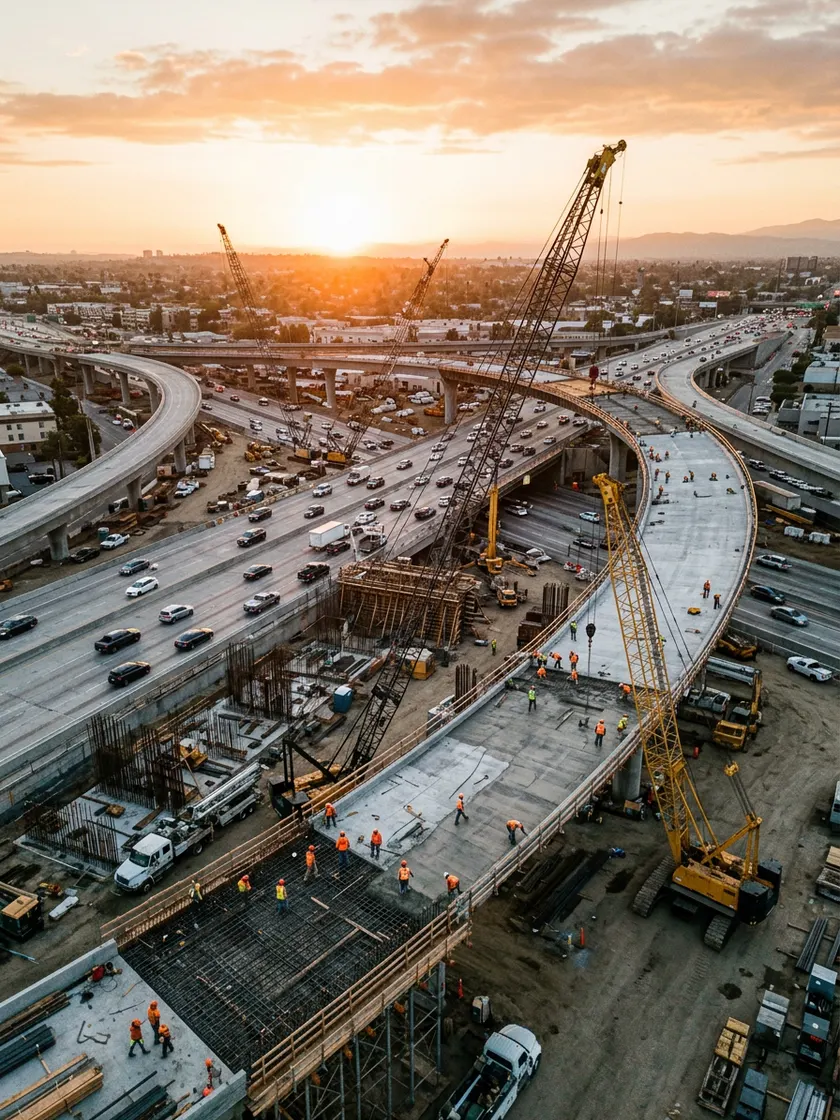
Transportation is one of the more predictable parts of the market. SB 1, the Road Repair and Accountability Act of 2017, generates roughly $5 billion a year for state highways and local streets and roads. Caltrans' State Highway Operation and Protection Program (SHOPP) funds repair and rehabilitation statewide. Federal money under the Infrastructure Investment and Jobs Act continues through federal fiscal year 2026, but what Congress does after that is uncertain. Contractors planning beyond 2026 should treat federal-aid volume as an open question.
In Los Angeles, LA Metro and the City of Los Angeles are speeding up transit, street and mobility projects ahead of the 2028 Olympic and Paralympic Games. Expect related work through 2026 and 2027. Much of it will be on tight schedules with little tolerance for slipped milestones.
High-speed rail is the caution flag. In 2025 the federal government terminated roughly $4 billion in grants to the California High-Speed Rail Authority. The authority challenged the move, and you should check the current status before relying on it. Central Valley work has continued with state funding. Subcontractors there should read payment terms closely and know exactly which funding source backs their contract before they commit.
Many small firms skip Caltrans and federal-aid local work because they assume it belongs to large primes. That is a mistake. Federally funded projects carry Disadvantaged Business Enterprise requirements, and primes look for certified subs to meet them. Certification runs through the California Unified Certification Program. Firms should also know that the U.S. Department of Transportation changed DBE eligibility rules in fall 2025. Owners now generally have to show individual disadvantage rather than rely on presumptions, and existing certifications are being re-evaluated. How goals are set during the transition can vary, so confirm your status and current project requirements with CUCP and the Caltrans Office of Civil Rights. Where primes still have to document good faith outreach, the solicitation ads they place in certified trade papers such as The Daily Reporter are a good place to spot subcontracting opportunities.
Rebuilding Los Angeles after the Palisades and Eaton fires
The January 2025 Palisades and Eaton fires destroyed more than 16,000 structures. The recovery is one of the largest residential rebuilding efforts in state history, and it will last years. Governor Newsom issued executive orders suspending CEQA and certain Coastal Act requirements for like-for-like rebuilds. The City of Los Angeles and Los Angeles County opened dedicated rebuild permitting centers to move approvals faster.
Faster permits do not mean lighter technical requirements. Many rebuilds must meet current wildland-urban interface standards, including ember-resistant vents, noncombustible siding and fire-resistant roofing. Those standards have long lived in Chapter 7A of the California Building Code, and the state has been moving them into a standalone wildland-urban interface code in the 2025 Title 24 cycle. Confirm which edition governs each permit with the local building department.
Before chasing rebuild work, check that your firm has the basics in place:
- An active CSLB license in the correct classification
- Workers' compensation coverage on file with CSLB
- Working knowledge of the wildland-urban interface requirements
- Relationships with the architects and engineers designing rebuilds
- Supplier commitments for fire-resistant materials
- Written contracts that meet the home improvement rules in Business and Professions Code Section 7159, where they apply
The legal exposure is serious. Under Business and Professions Code Section 7028.16, contracting without a license on repairs to property damaged in a declared emergency is a felony. CSLB has run enforcement sweeps in fire zones. If you subcontract any work, verify every sub's license on CSLB's website before they step on site.
Most fire survivors are paying for rebuilds through insurance claims. Contractors who produce detailed, itemized estimates and respond quickly to adjuster questions make the process easier for owners, and that tends to win referrals in neighborhoods where everyone is rebuilding at once.
Costs, compliance and the private market heading into 2026
Private commercial work will stay mixed. Office construction remains weak, while some industrial, healthcare and multifamily projects continue. Housing policy has shifted toward faster approvals. The 2025 budget trailer bills AB 130 and SB 131 created new CEQA exemptions and streamlining aimed at urban infill housing, which favors builders who work on infill sites.
Costs will be the hardest thing to manage. Tariffs on steel, aluminum and lumber, along with ongoing labor shortages, can wipe out a margin on a fixed-price bid. Get supplier quotes with clear expiration dates. Ask whether the owner will accept escalation language. Price the risk into the number instead of hoping prices hold.
Compliance is tightening too. Under SB 216, passed in 2021, every licensed contractor must carry workers' compensation insurance starting January 1, 2026, whether or not the firm has employees. Sole owners who have relied on an exemption need a policy on file with CSLB, so confirm the details and deadlines with CSLB.
The practical move this month is to audit your paperwork against the work you want. Make sure your DIR registration, certifications, workers' compensation coverage and license classifications are current, then get on the bidders' lists of two or three agencies that will spend bond, transportation or rebuild money near you. The firms that win in 2026 will be the ones already qualified when those bids open.