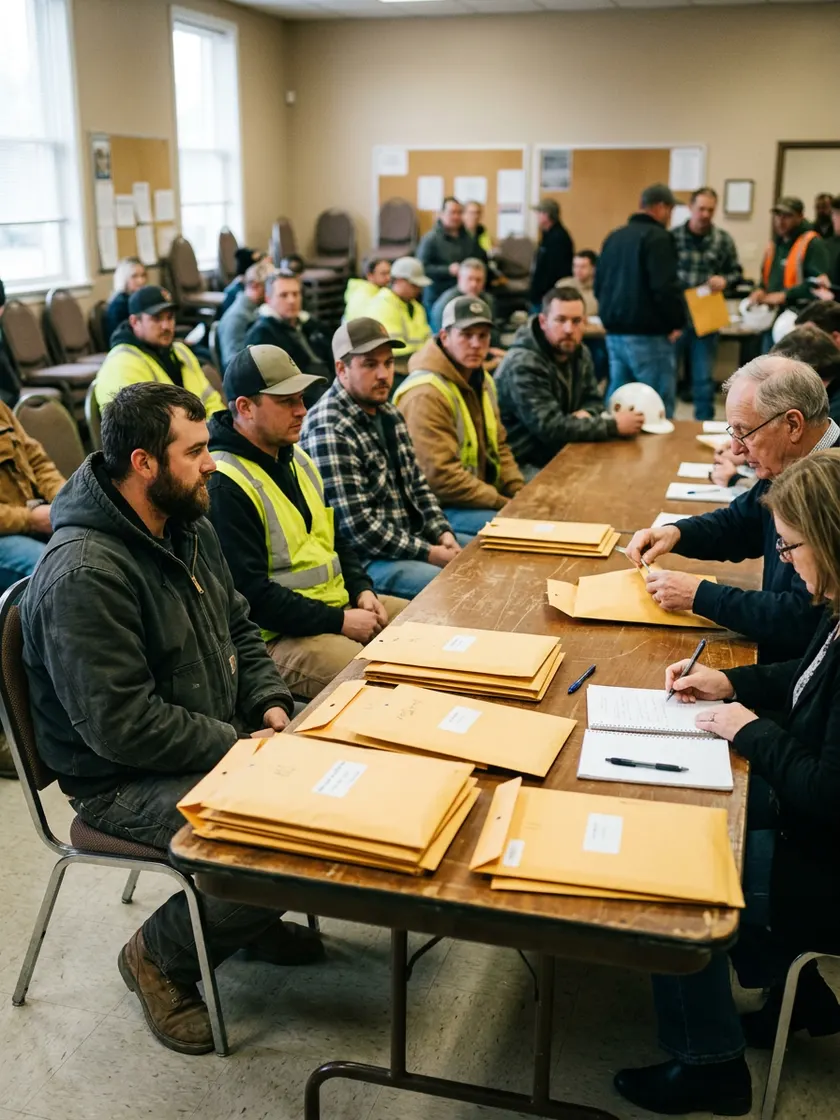
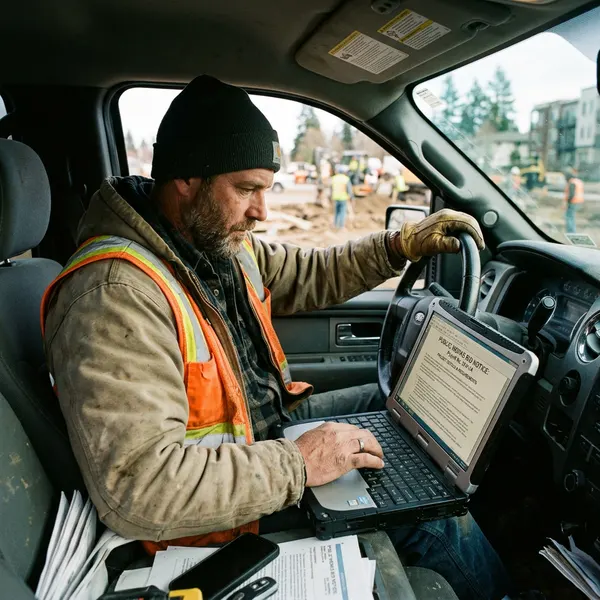
A contractor can turn in the lowest number at a bid opening and still lose the job. An unacknowledged addendum, a missing signature on the bidder's bond, or a subcontractor left off the listing form is enough for an awarding agency to declare the bid nonresponsive and move to the next name on the tabulation. California cities, counties, school districts and state agencies award a large volume of construction work every year, and small and mid-size firms win much of it. The firms that win steadily are the ones that treat responsiveness as seriously as price.
Thresholds and fees in this area change periodically. Before you rely on any figure below, confirm it with the code section, the agency named, or the bid documents in front of you.
What makes a job public works, and why it changes your paperwork
California Labor Code Section 1720 defines public works as construction, alteration, demolition, installation or repair work done under contract and paid for in whole or in part with public funds. Maintenance work is also covered under the prevailing wage law. Once a project falls under that definition, it carries a different set of rules from private work, and those rules follow the contract from bid day to final payment.
Prevailing wage applies to public works projects over $1,000. Contractors and subcontractors must register with the Department of Industrial Relations to bid on or perform most public works. Projects of $25,000 or less for new construction, alteration, installation, demolition or repair are exempt from registration, as are maintenance projects of $15,000 or less. Bonding, subcontractor listing and certified payroll requirements come with the contract, and the awarding agency's documents will spell out how each one applies.
Not every public solicitation is decided the same way, so figure out what kind you are looking at before you spend estimating hours. The traditional format is the invitation for bids, often titled a notice inviting bids. The contract goes to the lowest responsive, responsible bidder. Price decides it, but only if your package is complete and correct.
A request for proposals works differently. Agencies use RFPs for design-build, best-value procurements, job order contracting and some lease-leaseback school projects, and your submittal is scored on qualifications, approach and schedule along with price. Local agencies procure design-build under Public Contract Code Section 22160 and following, and school districts use Education Code Section 17250.10 and following. Read the evaluation criteria closely, because a strong price will not rescue a thin qualifications section.
The third category catches many contractors off guard. Hundreds of California cities, counties and districts have adopted the Uniform Public Construction Cost Accounting Act, found at Public Contract Code Section 22000 and following, which lets them use simpler procedures on smaller jobs. Under the current thresholds, projects of $75,000 or less can be done by the agency's own forces, by negotiated contract or by purchase order. Projects up to $220,000 can be bid informally, and anything larger requires formal advertised bidding. These limits have been raised before and will be again, so check the current figures with the agency.
Informal bidding rewards contractors who do a little legwork. Participating agencies must keep a list of qualified contractors and update it at least once a year, and informal bid notices go to the firms on that list as well as to construction trade journals designated for the county. Call the public works department of each agency you want to work for and ask how to get on its list. These solicitations often draw fewer competitors than advertised formal bids, which makes them a practical entry point for a smaller firm.
Credentials to line up before the right job appears
Several prerequisites take weeks to complete, so get them done before you find the project you want. Start with your Contractors State License Board license. Under Business and Professions Code Section 7028.15, a bid from a contractor who is not properly licensed is generally nonresponsive. Projects with federal funding can follow different timing rules, so read the bid documents. Confirm on the CSLB site that your license, workers' compensation coverage and license bond are all current, and that your classification matches the work.
Next comes DIR public works contractor registration. The annual fee is currently $400, and you can register for up to three years at once. Your subcontractors must also be registered at the time of bid, because a bid cannot list an unregistered sub. Bidding before your own registration is active is a common and avoidable mistake. The agency can reject the bid, and a contract with an unregistered contractor is subject to cancellation.
Bonding takes lead time too, so talk to a surety broker well before bid day. Most formal bids require a bid bond, typically 10 percent of the bid. Civil Code Section 9550 requires a payment bond on public works contracts over $25,000, and agencies typically require a performance bond for 100 percent of the contract price. Insurance requirements vary, but $1 million per occurrence and $2 million aggregate in general liability is a common baseline. Agencies usually also require auto coverage, workers' compensation and often an umbrella policy, and larger projects may require higher limits.
Certifications are optional, but they can open doors. The Department of General Services certifies Small Businesses and Disabled Veteran Business Enterprises through Cal eProcure. State agencies work toward a 25 percent small business participation goal and a 3 percent DVBE goal. For federally funded transportation work, DBE certification comes through the California Unified Certification Program. On those jobs, primes conducting good faith outreach will be looking for certified firms in your trade.
Where California agencies actually post their work
California has no single statewide bid board, so you need to watch several sources. At the state level, Caltrans posts construction contract advertisements in the contracts and procurement section of its website and takes electronic bids through Bid Express. Cal eProcure carries solicitations from DGS and many other state agencies. University of California and California State University campuses each run their own procurement portals.
Local agencies are more scattered. The City of Los Angeles uses RAMP L.A., its Regional Alliance Marketplace for Procurement. The City of San Diego and many other cities and districts use PlanetBids, where each agency keeps its own vendor portal, so you have to register separately with each one. Other agencies post on BidNet Direct, OpenGov Procurement or their own websites. A practical approach is to register with the agencies closest to your shop and set up the commodity or trade categories each portal offers, so notices come to your inbox automatically.
Regional builders' exchanges in Sacramento, San Diego, Southern California, the Bay Area and elsewhere collect public bids and host plans. Paid services such as Dodge and ConstructConnect can cut down on search time. Formal notices inviting bids also run in newspapers and trade publications, including The Daily Reporter. That is also where many primes place the outreach ads required to document good faith efforts on DBE and other participation goals. If you are a certified sub, those ads are a direct lead to primes who need your trade on a specific job.
Deciding whether a bid is worth your estimator's week
A public works estimate can easily consume a week or more of staff time, and that time is wasted on a job you cannot legally bid, bond or staff. Run every opportunity through a quick go/no-go review before anyone opens a takeoff:
- Is my license classification listed as acceptable in the bid documents?
- Can my surety support a bond for this contract amount on top of my current backlog?
- Are my DIR registration and those of my likely subs active, and will they stay active through the work?
- Can I meet the insurance limits and any DBE, SB or DVBE participation goals, or document a good faith effort?
- Does the schedule fit my crews, and can I attend any mandatory pre-bid meeting or site walk?
- Do I know the owner, the inspector and the payment track record well enough to price the risk?
If the answers hold up, build your responsiveness checks into the estimate from the start. Under the Subletting and Subcontracting Fair Practices Act, Public Contract Code Section 4100 and following, you must list every subcontractor whose work exceeds one-half of 1 percent of your total bid. On street, highway and bridge projects, the threshold is one-half of 1 percent or $10,000, whichever is greater. Track every addendum and acknowledge each one on the bid form. Have the person authorized to bind the company sign everywhere a signature is required.
Before your next bid date, pull your CSLB record, your DIR registration status and a letter from your surety, and confirm that all three are current. Then call two or three nearby agencies and ask how to get on their informal bidding lists. That hour of administrative work is what lets your low number count when the bids are opened.