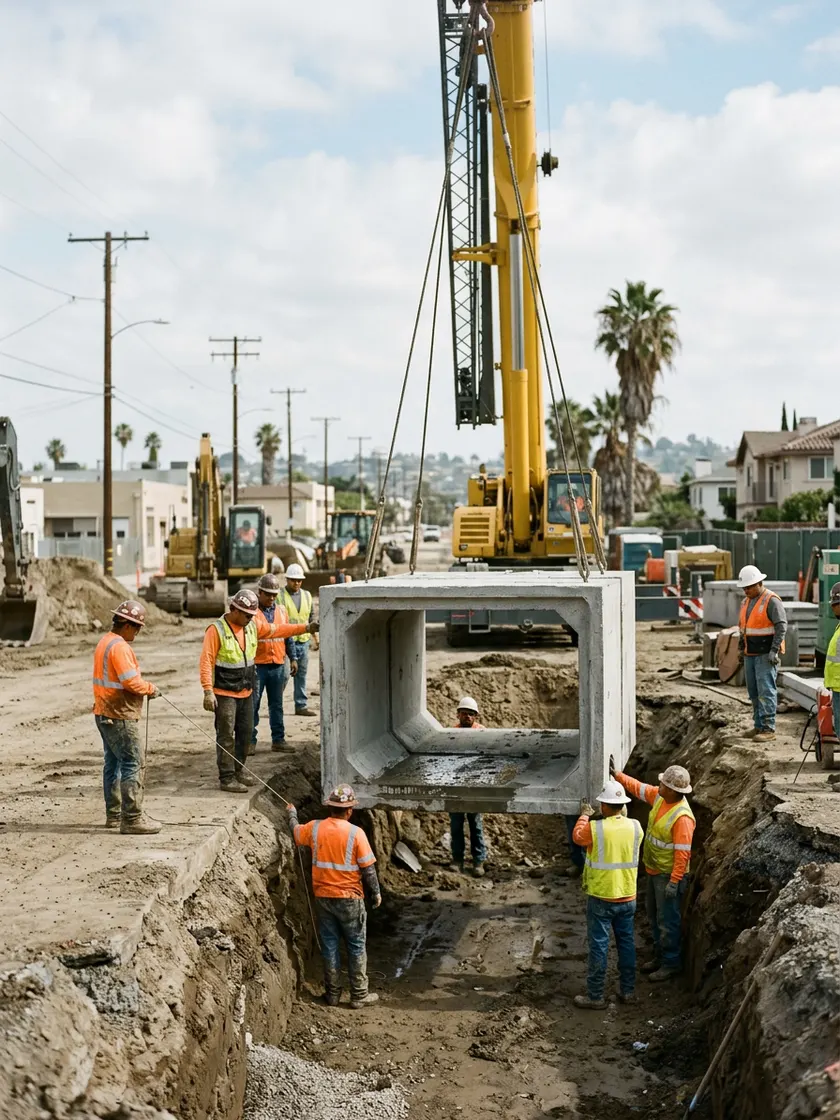
Picture opening day at a county bid opening. Your number comes in lowest on a storm drain rehabilitation job, and a week later the county finds that the electrical subcontractor you listed was not registered with the Department of Industrial Relations when bids were due. The award goes to the second bidder. On Los Angeles County Public Works projects, the lowest price only matters if the bid is responsive, and a bid can be rejected over paperwork that had nothing to do with your estimate.
Los Angeles County Public Works runs one of the largest public infrastructure portfolios in the country. It covers county roads, flood control channels, storm drains, county buildings and airports, and it advertises a steady stream of construction work every year. For small and mid-size firms, that is a real pipeline. The rules are strict, though, and most lost bids trace back to a short list of avoidable mistakes. Fees, thresholds and procedures change, so treat what follows as a map and confirm the details in each project's bid documents.
Why "Los Angeles public works" means several different agencies
Contractors new to the region often assume "Los Angeles" is one buyer. It is several, and each has its own bid portal, registration process and local programs. Los Angeles County Public Works handles county roads, flood control, storm drains, county facilities and unincorporated areas, and it posts work on its Contract Opportunities page. The City of Los Angeles bids streets, sewers and city facilities through the Los Angeles Business Assistance Virtual Network, known as LABAVN. LA Metro buys transit and rail work through its own vendor portal. LAUSD bids school facilities through its procurement office. The Port of Los Angeles and Los Angeles World Airports each run separate systems.
This guide covers the county. State-law requirements such as DIR registration, prevailing wage, bonding and subcontractor listing apply to all of these agencies. Local certifications, preference programs and portals do not carry over from one agency to another.
The registrations and bonds to line up weeks before bid day
Several of these items take weeks to process, so finish them before you start estimating a specific job. A firm that waits until it sees an attractive bid usually runs out of time.
- Confirm your Contractors State License Board license is active and in the classification the Notice Inviting Bids requires. Common examples are A (General Engineering), B (General Building) and C-12 (Earthwork and Paving). If you hold the wrong classification, the bid is non-responsive.
- Register with the Department of Industrial Relations as a public works contractor, as required by Labor Code sections 1725.5 and 1771.1. The fee is $400 a year, and you can register for up to three years at once. Every subcontractor you list must also be registered when bids are due.
- Register as a vendor with Los Angeles County through its Doing Business portal. Registration gives you a vendor number and lets you receive notifications.
- Meet with a surety broker to set your bonding capacity before you need a bond.
The DIR registration requirement has a small-project exemption. It does not apply to projects of $25,000 or less for construction, alteration, demolition or repair, or $15,000 or less for maintenance. The exemption covers registration only. Prevailing wage still applies to most public works over $1,000, so the exemption does not free you from paying the correct rates.
On bonding, county construction bids typically require bid security of 10 percent of the bid amount, in the form of a bid bond, cashier's check or certified check. The winning bidder usually provides a performance bond for 100 percent of the contract price. Civil Code section 9550 requires a payment bond for 100 percent of the contract price on public works contracts over $25,000. A newer firm with limited financial history may start with a modest single-job limit. Smaller county jobs such as sidewalk repair, ADA curb ramps and minor storm drain work are a practical way to build a performance record, and each completed job helps make the case for more capacity.
County certifications that can open doors
The county's Department of Economic Opportunity runs small business certification through its Office of Small Business. It offers Local Small Business Enterprise (LSBE), Social Enterprise (SE) and Disabled Veteran Business Enterprise (DVBE) certification. Certification is free. It can qualify you for preference programs and outreach events, and it makes you more visible to primes looking for participation on their teams.
Preference rules for construction contracts are not the same as those for goods and services, so do not assume a certification earns a bid preference on a public works job. Read the bid instructions for each project. Public Works also tracks Community Business Enterprise participation, which covers minority-, women-, disadvantaged- and disabled veteran-owned firms. Expect to fill out a CBE form with your bid even when no preference applies.
Firms certified as DBEs should watch for projects that carry federal funds. Those projects bring federal DBE goals and good faith effort requirements. Primes on those jobs often show their outreach by advertising subcontracting opportunities in trade and focused publications, including The Daily Reporter. Those notices are a useful source of leads for certified subs.
Finding bids and reading the contracting method
Sign up for notifications on the county's Contract Opportunities page, and download the complete bid package for any project you pursue. The package includes the Notice Inviting Bids, specifications, plans, bid forms and every addendum. Register as a planholder where the system allows it, so addenda reach you automatically and you are not relying on someone else to forward them. The planholder list is also useful intelligence. It shows which primes are looking at a job and may need your trade.
Learn which contracting method a project uses, because it changes how you compete. Larger projects go out as formal competitive bids. They are publicly advertised, bid sealed or electronically, and awarded by the Board of Supervisors to the lowest responsive, responsible bidder. The county also uses Job Order Contracting for repair and renovation work. Under a JOC contract, a single contractor receives a series of task orders priced against a unit price book, usually by applying a bid adjustment factor. JOC can provide steady work for firms that handle many small, varied jobs well. Read the specific solicitation for how that county program is structured.
Where responsive bids fall apart
Most rejected bids fail on documents, not on pricing. The subcontractor list is a frequent problem. Under the Subletting and Subcontracting Fair Practices Act, a prime must list every subcontractor whose work exceeds one-half of 1 percent of the prime's total bid. On street, highway and bridge work, the threshold is one-half of 1 percent or $10,000, whichever is greater. Each listed sub must be DIR-registered and properly licensed. Substituting a listed sub after award requires the agency's approval and a legal basis under the statute.
Other common failures are missed addendum acknowledgments, unsigned forms, bid security in the wrong amount or form, and late submissions on electronic portals that lock out uploads at the deadline. Before you submit, check the bid against the instructions to bidders line by line, and leave enough time to fix whatever that review turns up.
Your next step is to confirm your DIR registration and your license classification today, then call your surety before you need a bond. Once those are in place, sign up for county bid notifications, choose a small project that fits your trade, and use it to build your record with the county.