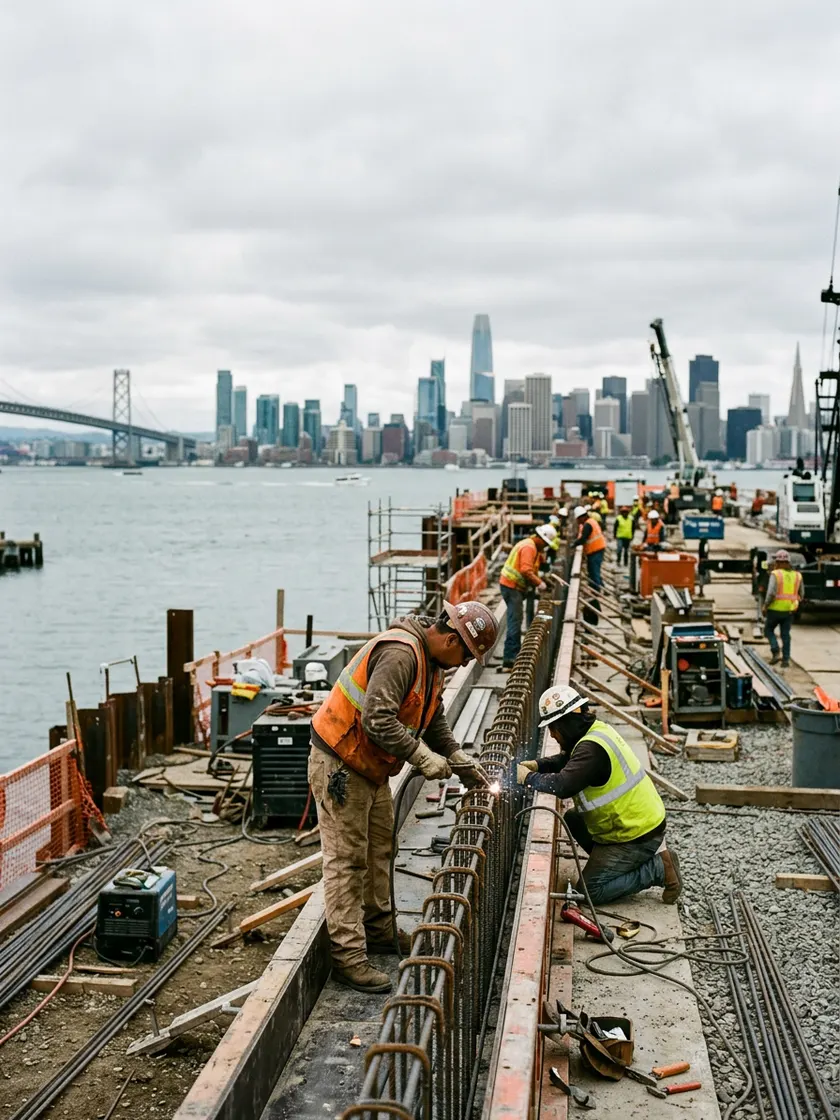
The apparent low bidder on a San Francisco street job can lose the award for reasons that have nothing to do with price. A listed subcontractor turns out not to be registered with the state. A required city business registration is missing from the file. Or the firm can't meet the local hiring percentage, and the penalties would wipe out its margin. In the Bay Area, paperwork and program rules decide as many contracts as bid totals do.
That matters because there is a great deal of work to win. Over the past decade, Bay Area voters have approved large bond measures for transit, water and sewer systems, schools and seismic upgrades, and the agencies spending that money need contractors of every size. This guide covers where the money is, who is buying, what to register for before you bid, and the local rules that catch firms used to bidding elsewhere in California.
Where the Bay Area's bond money is going
Much of the region's urban infrastructure was built before modern seismic codes, and several funding sources are now paying to rebuild it. BART's Measure RR, approved in 2016, authorized $3.5 billion for track, power and structural work across the system. In San Francisco, the 2020 Earthquake Safety and Emergency Response bond provided $628.5 million for public safety and emergency response facilities. The 2020 Health and Recovery bond added $487.5 million for parks, streets and mental health facilities.
Across the bay, Oakland voters passed Measure U in 2022, an $850 million bond for affordable housing, streets and public facilities. The San Francisco Unified School District's Proposition A, approved in 2024, provides $790 million for school modernization and repairs. Underneath all of it sits the San Francisco Public Utilities Commission's Sewer System Improvement Program, a multi-billion-dollar effort that runs for decades.
Not every bond dollar becomes a construction contract, and spending stretches over many years. Still, these programs break into a steady stream of smaller jobs. Prime contracts and subcontracts in the $50,000 to $2 million range for paving, concrete, electrical, roofing, ADA upgrades and plumbing are common, and that is where small firms can compete on equal footing.
The agencies doing the buying
Each Bay Area agency runs its own procurement, with its own posting system, rules and small business program. Within the City and County of San Francisco, the main buyers are San Francisco Public Works (streets, buildings and bond-funded facilities), the SFPUC (water, sewer and power), and the SFMTA (transit, signals and streetscapes). San Francisco International Airport and the Port of San Francisco also buy large volumes of construction. Check each department's contracting page and the city's supplier systems, because they do not all advertise in the same place.
Regional buyers add to the list. BART handles stations, track and Measure RR rehabilitation. Caltrans District 4 covers state highways in all nine Bay Area counties and takes electronic bids through Bid Express. Santa Clara VTA manages transit and highway work, including the BART Silicon Valley Phase II extension. The cities of Oakland and San José, the counties, and school districts such as SFUSD, Oakland Unified and San José Unified round out the field, along with dozens of smaller districts that have bond programs of their own.
Registrations to finish before you find a job worth bidding
Registration gaps are among the most avoidable ways to lose a winnable bid. Handle them now, before a deadline forces the issue.
- Confirm your CSLB license is active, carries the right classification for the work, and is backed by the required $25,000 contractor's bond. On most state and local jobs the license must be in order when you submit the bid, though federally funded projects can be handled differently, so check the bid documents. You can verify your status at cslb.ca.gov.
- Register with the Department of Industrial Relations as a public works contractor. The annual fee is currently $400. Registration is required on projects over $25,000 for construction, alteration, demolition, installation or repair, and over $15,000 for maintenance. Confirm current figures with DIR, since fees and rules change.
- Register with each agency you plan to bid. San Francisco requires supplier registration and a Business Registration Certificate from the Treasurer and Tax Collector. Oakland has its own supplier portal, and state work runs through Cal eProcure.
Your subcontractors must be DIR-registered too. State law offers only narrow cures for listing an unregistered sub by mistake, and relying on them is a gamble. Run every sub you plan to list through DIR's online search of registered contractors before bid day.
Certifications and bonding that decide which bids you can win
Small business certifications can earn bid discounts or count toward participation requirements, but each program is separate. San Francisco's Local Business Enterprise program, administered by the Contract Monitoring Division under Chapter 14B of the city's Administrative Code, has Micro-LBE, Small-LBE and SBA-LBE tiers. Oakland's Local and Small Local Business Enterprise program generally sets a 50 percent participation requirement on construction contracts. Confirm the applicable thresholds in each solicitation. State SB and DVBE certification goes through the Department of General Services.
Federally funded work through Caltrans and the transit agencies relies on DBE certification, issued through the California Unified Certification Program. When a prime falls short of a DBE goal, it has to document good faith efforts, and those efforts often include outreach ads in trade and focused publications such as The Daily Reporter. DBE subs should watch those ads closely. Processing times for all of these certifications vary, so apply well before you need one.
Bonding sets the ceiling on what you can pursue. Bid bonds usually run 10 percent of the bid, and California requires a payment bond on public works contracts over $25,000. Most agencies also require a 100 percent performance bond. Ask your surety for written single-project and aggregate limits so you know which jobs are realistic.
San Francisco rules that sink otherwise low bids
San Francisco's Local Hiring Policy requires that a share of work hours on covered public works projects be performed by city residents. The requirement is generally 30 percent per trade, with part of that share going to disadvantaged workers. It applies above a dollar threshold that is adjusted annually. The policy is administered by the Office of Economic and Workforce Development, whose CityBuild program can refer qualified residents. Shortfalls carry financial penalties, so map your crew's residency before you price the job rather than after award.
Some large projects at agencies such as the SFPUC, SFO and BART are covered by project labor agreements. Non-union contractors can usually still bid, but they must follow the agreement's hiring hall and benefit contribution rules. Read the agreement in the bid package before you build your labor numbers.
Prevailing wage applies to public works over $1,000. Use the DIR wage determinations in effect when the project was advertised. Certified payroll goes to the Labor Commissioner electronically, and many awarding agencies require their own compliance reporting on top of that.
The move to make this week is a registration audit. Pull your CSLB and DIR status, run your regular subs through the DIR search, confirm your San Francisco business registration, start any certification applications you have been putting off, and get your surety limits in writing. Then you'll be ready when the right bid posts.