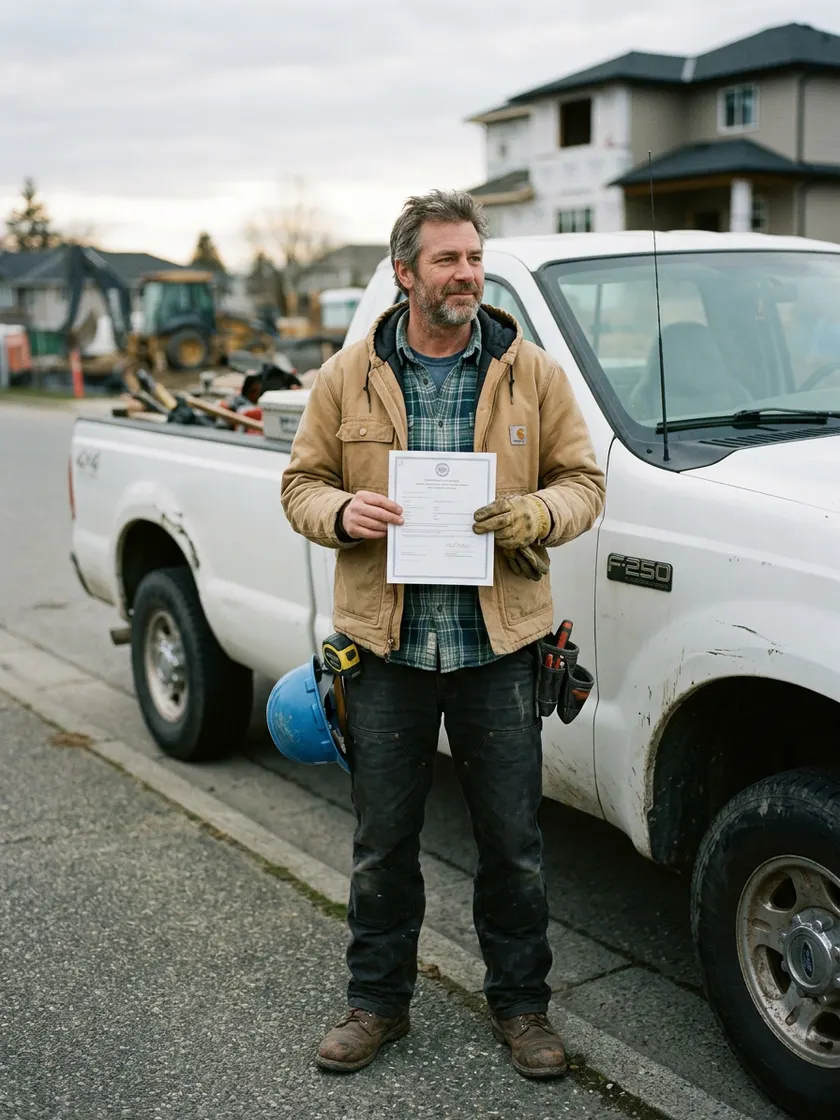
A foreman who has run crews for a decade can still lose a job, and the money owed on it, over a missing piece of paper. In California, any job where labor and materials together come to $1,000 or more requires a license from the Contractors State License Board. So does work that needs a building permit, no matter how small the price. The dollar threshold doubled from $500 on January 1, 2025, when AB 2622 took effect, but the consequences of crossing it without a license did not get any softer.
Contracting without a license is a misdemeanor. A first conviction can bring a fine of up to $5,000, up to six months in county jail, or both. The civil exposure often hurts more. Under Business and Professions Code Section 7031, an unlicensed contractor cannot sue to collect payment for the work, and the client can sue to recover money already paid.
On public works, the license also has to be in place before you bid, or in some cases before award. Bid documents spell out which classification the agency requires and when it must be held, so read that section before you price the job.
The licensing process itself is predictable once you know its sequence: requirements, classification, business entity, experience, exams and bonding. Fees, bond amounts and thresholds change periodically. The figures below were current at this writing, and the CSLB website is the place to confirm them before you file.
What the CSLB requires of you before you apply
Every license needs a qualifying individual whose experience and exam results stand behind it. That can be the owner or a designated manager. The qualifier must be at least 18 and have a Social Security number or an Individual Taxpayer Identification Number. The qualifier also needs at least four years of journey-level experience in the trade within the last ten years. All owners, officers and qualifiers must be fingerprinted through Live Scan for a background check, and the qualifier must pass the Law and Business exam and the trade exam unless a waiver applies.
No high school diploma or college degree is required. Journey-level means you were fully qualified and could perform the trade without supervision. Time spent as a helper or apprentice does not count as journey-level, though a completed apprenticeship can earn credit.
Qualifying experience can come from several places. It can come from working for a licensed contractor, from serving as a journeyman, foreman or supervisor, or from owner-builder work on your own projects. Work in the same trade outside California also counts.
Education can shorten the clock. The CSLB grants up to three years of credit for an accredited degree in construction management, architecture or engineering. It grants up to three years for a completed apprenticeship program and up to a year and a half for technical training in a related field. Regardless of credit, every applicant needs at least one year of hands-on, practical experience. The board decides how much credit to allow, so treat these as ceilings rather than guarantees.
Choosing a classification that matches the work you bid
Picking the wrong classification is one of the most common and costly mistakes applicants make. On public works, the agency names the classification it requires, and a mismatch can sink an otherwise good bid. California licenses fall into three broad groups.
The A General Engineering license covers fixed works that require specialized engineering knowledge, such as grading, paving, sewers, bridges and pipelines. The B General Building license covers structures involving two or more unrelated trades, such as new homes, commercial buildings and major additions. The B-2 Residential Remodeling license covers non-structural remodeling of existing homes involving three or more unrelated trades, such as kitchen and bath remodels and finish work. The C Specialty licenses number around 40 and each covers a single trade. Examples include C-10 Electrical, C-36 Plumbing, C-20 for HVAC and C-33 Painting and Decorating.
The practical way to choose is to list the work you actually do in a typical month and match each task against the CSLB's published classification descriptions. If you coordinate several trades, look at the B or B-2. Keep one limit in mind: a B contractor generally cannot take a prime contract for a single specialty trade other than framing or carpentry. To take that work, the B contractor has to hold the matching C license or subcontract it to someone who does.
Consider a handyman who mostly does drywall, painting and flooring in homes. A C-33 painting license would not cover that mix of work, but a B-2 might.
The smart move is to start with the one classification you can document best. Once licensed, you can add classifications later, at $150 each at this writing. You will still need to show experience in each added trade and pass its trade exam unless a waiver applies.
Setting up the business the license will belong to
The license is issued to a business entity, and that choice affects bonding, insurance and fees. A sole proprietor is the simplest and cheapest option, and the owner usually serves as the qualifier. A partnership qualifies through a qualifying partner or a Responsible Managing Employee. A corporation qualifies through a Responsible Managing Officer or a Responsible Managing Employee.
Corporations and LLCs must be registered and in good standing with the California Secretary of State before you apply. One of the most avoidable delays is filing with the CSLB while the entity is still pending with the state. The board will reject or hold the application until the entity is active.
Every licensee must post a $25,000 contractor bond. A qualifying individual who is a Responsible Managing Employee, or a Responsible Managing Officer owning less than 10 percent of the company, generally needs a separate $25,000 bond of qualifying individual.
LLCs carry two extra requirements. The first is a $100,000 employee and worker bond on top of the contractor bond. The second is liability insurance of at least $1 million when five or fewer people are listed on the license, rising by $100,000 for each additional person up to a $5 million cap. Price those costs before you settle on an LLC.
Building an experience record that holds up to review
The Certification of Work Experience is the heart of the application. Weak documentation is a common cause of delays and can trigger a closer CSLB investigation.
Each certifier must have direct knowledge of your work. That can be a current or former employer, a coworker or foreman, a licensed contractor you worked alongside, a client, a union representative or a building inspector. Applicants generally cannot certify their own experience. If you were self-employed, expect the board to ask for backup records to support your account.
Before you sit down with the form, assemble the following:
- Exact dates of each job, by month and year
- Your job title and the journey-level duties you performed
- Names and contact information for each certifier
- W-2s, 1099s or pay stubs covering the period
- Union records or apprenticeship completion certificates
- Building permits you pulled, if you worked as an owner-builder
- Contracts, invoices or project photos
Specificity is what separates a clean approval from a flagged file. "General construction work" invites questions. A stronger description reads more like this: installed residential service panel upgrades from 100 to 200 amps, plus branch circuits and lighting, in more than 40 single-family homes over four years. It would also say the work was done without supervision as lead electrician for a named licensed contractor, with that contractor's license number. The CSLB randomly selects applications for detailed review, so write yours as if it will be one of them.
Moving from application to license on the board's timeline
You can apply online through the CSLB's online services or by mail. The application fee was $450 after the board's most recent increase. A separate initial license fee comes due later, and that fee differs for sole owners and other entities, so check the current fee schedule before you pay. Once the board accepts the application, it notifies the qualifier of exam eligibility. The application generally expires if the required exams are not passed within 18 months of acceptance.
After passing, the clock tightens. You typically have 90 days to submit the contractor bond, any required qualifier or LLC bonds, and the initial license fee. You must also submit proof of workers' compensation coverage or a certificate of exemption if you have no employees. Certain classifications, roofing among them, must carry workers' comp regardless of whether you have employees, and lawmakers have been widening that requirement. Confirm the rule for your classification before you file. Miss the 90-day window and you risk starting over.
Processing times vary with the board's workload, and the CSLB posts current estimates on its website. Plan around those estimates rather than a number you heard from another contractor.
For firms headed into public works, the license is a first step rather than the finish line. Most contractors bidding public projects must also register with the Department of Industrial Relations, with narrow exceptions for small projects. Small business and DBE certification through DGS or the Caltrans-administered program follows its own separate process.
Start this week by pulling the CSLB classification description for the work you do most. Then begin collecting pay records and certifier contacts before you spend a dollar on fees. A file that is complete on day one is the best protection against months of back-and-forth with the board.